Artificial intelligence is increasingly moving beyond generating text inside a controlled interface. AI agents and AI-enabled enterprise applications can interact with external systems, retrieve information from the web, follow links, conduct research, and take actions on behalf of users and organizations.
These capabilities can make AI considerably more useful. They also introduce an important security question: Where should an enterprise AI system be allowed to go on the Internet?
Just as organizations establish policies governing where employees and applications can connect, AI systems that interact with external web resources need boundaries of their own. URL and web intelligence can provide an important foundation for building those AI guardrails.
AI Is Becoming an Active Internet User
Traditional generative AI applications primarily responded to information supplied by a user. Increasingly, however, AI systems are being given tools that allow them to interact with resources outside of the model itself.
An AI agent might search the web to answer a question, retrieve documentation to solve a technical problem, access a website as part of a business workflow, or collect information from multiple online sources before taking an action. As AI agents become more autonomous, the number and variety of external destinations they encounter can grow substantially.
This creates a new type of web security challenge. An organization may trust the AI system itself while still needing to control the external resources that system can access.
Why AI Agents Need Web Access Guardrails
Giving an AI system unrestricted Internet access can expose it to destinations that an organization would never intentionally approve.
Some destinations may contain malicious content. Others may be associated with phishing, malware, hacking, or other security threats. An AI agent could encounter adult content, illegal material, gambling, anonymizers, or other resources that violate corporate policies. Even legitimate websites may be inappropriate for a particular AI application or workflow.
The challenge becomes more complicated as AI systems operate with greater autonomy. A human employee typically makes a conscious decision to visit a website. An AI agent may discover and access destinations dynamically while attempting to accomplish a broader task. Security organizations such as OWASP have identified risks associated with LLM and agentic systems interacting with external resources and taking actions with increasing autonomy.
Organizations therefore need a way to evaluate destinations as AI systems encounter them and apply policy before access is permitted.
Moving Beyond Static Allow and Block Lists
The simplest AI web guardrail would be an allowlist: an AI application can access a predetermined collection of approved domains and nothing else.
That approach may work for tightly controlled workflows, but it becomes limiting when an AI system is expected to conduct research, discover information, or interact with the broader web. Maintaining exhaustive lists of acceptable destinations can also become impractical as the Internet continually changes.
Web categorization provides another approach.
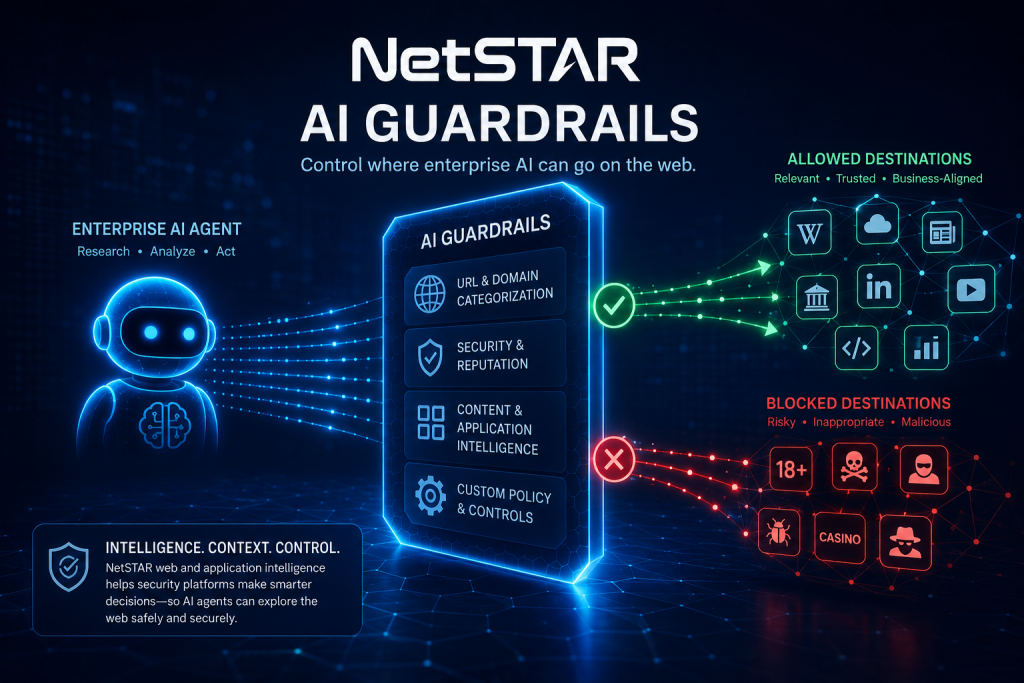
Rather than requiring an organization to make an individual policy decision about every URL an AI system might encounter, destinations can be evaluated according to their content, purpose, and risk. The organization or security platform can then establish policies around those classifications.
An enterprise might permit an AI research agent to access technology, business, news, government, and educational resources, for example, while preventing access to categories that are irrelevant, inappropriate, or potentially dangerous.
The guardrail becomes policy-driven rather than simply list-driven.
URL Intelligence as an AI Guardrail
NetSTAR’s inCompass technology provides categorization intelligence for URLs and domains that can be incorporated directly into another vendor’s application or security platform. Categorization results can include primary and secondary content categories, security categories, reputation information, and other contextual data.
That intelligence can provide an input into an AI access decision.
When an AI system attempts to access an external URL, the platform can evaluate that destination using NetSTAR intelligence and apply its own policy. Depending on the organization’s requirements, the platform might permit the request, deny it, route it for additional inspection, or apply another control.
Importantly, NetSTAR does not need to determine the organization’s AI policy. The OEM partner or enterprise platform establishes and enforces the guardrail. NetSTAR provides intelligence about the destination that can help the platform make that decision.
Granularity Matters When AI Is Exploring the Web
Domain-level controls alone may not always provide sufficient context. A single website can contain many different types of content, and the appropriate policy for one portion of a site may differ from another.
NetSTAR supports URL categorization and multiple URL-matching methodologies, allowing categorization decisions to extend beyond a simple domain-level classification. This can become particularly valuable for AI systems capable of navigating dynamically discovered links and resources.
NetSTAR also supports user-defined categories and URLs, allowing an integrating platform to supplement NetSTAR intelligence with its own classifications. The User URL DB can be used to assign specific URLs to NetSTAR or custom categories, effectively supporting customized allow/block policy inputs.
This combination of broad Internet intelligence and customer-specific policy can provide AI security vendors with greater flexibility than either static lists or broad domain controls alone.
Security Intelligence Adds Another Layer of Protection
Content classification answers an important question: What is this destination?
Threat intelligence adds another: Does this destination present a known risk?
NetSTAR’s URL intelligence can identify security categories associated with malicious or harmful destinations. The documented inCompass security taxonomy includes classifications for malware, phishing sites, spyware, botnets, infected sites, hacking/cracking, mobile malware, keyloggers, and bot phone-home activity.
For an AI system autonomously exploring external resources, this information can provide another signal for determining whether a connection should proceed.
An organization might therefore create policies based both on the purpose of a destination and its security characteristics. A destination could be perfectly relevant to an AI agent’s assigned task but still be denied because it presents unacceptable security risk.
AI Guardrails Without Sacrificing AI’s Utility
The goal of AI web guardrails should not necessarily be to confine AI systems to a small collection of predetermined websites. Doing so could eliminate much of the value organizations hope to gain from AI agents capable of researching, discovering, and interacting with information independently.
The objective is to give AI systems controlled access to the open web.
Achieving that requires intelligence capable of evaluating destinations at Internet scale and providing enough context for another system to make an informed policy decision.
As enterprise AI evolves from systems that simply generate responses to systems capable of taking actions and interacting with the outside world, web access is likely to become an increasingly important security boundary.
Building Web-Aware AI Guardrails With NetSTAR
NetSTAR provides web categorization, reputation, application intelligence, and threat intelligence technologies designed for integration into OEM products. With flexible local, cloud, and hybrid deployment options, NetSTAR intelligence can be incorporated into security architectures where URL decisions need to occur as part of an application’s workflow.
For vendors developing AI security platforms, AI agents, secure enterprise browsers, data protection solutions, or other AI-aware security technologies, NetSTAR can provide an intelligence layer for understanding the external destinations those systems encounter.
As AI becomes more capable of navigating the Internet on its own, knowing where it is going—and deciding whether it should be allowed to go there—will become an essential part of securing enterprise AI.
Talk with NetSTAR about adding web intelligence to your AI security product.